

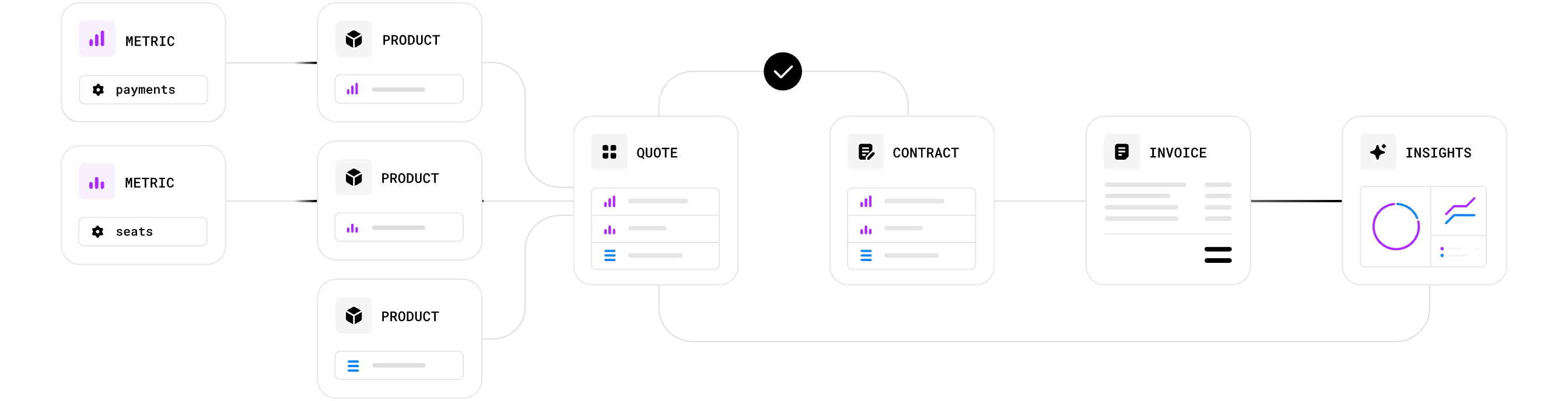
Billable Metrics
Units of measurement that determine how much a customer pays based on their actual usage. Real-world examples:- Twilio bills per SMS sent or API call made
- AWS S3 bills per gigabyte of storage used
- Snowflake bills per compute credit consumed
- Slack bills per active user in a workspace
CPQ / Quotes
Configure, Price, Quote — the process of creating customized pricing proposals for enterprise customers with complex needs. Real-world examples:- Salesforce enterprise deals with custom user counts, add-ons, and multi-year terms
- HubSpot packages combining Marketing Hub, Sales Hub, and Service Hub at negotiated rates
- Snowflake committed-use contracts with volume discounts based on projected consumption
Discounts
Price reductions applied to subscriptions or specific products. Real-world examples:- Spotify offers 50% off for students
- GitHub provides free or discounted plans for startups and nonprofits
- Annual billing discounts — most SaaS companies offer 15-20% off for paying yearly instead of monthly
- Volume discounts — Slack gives lower per-seat pricing as team size grows
Currencies
Support for billing customers in their local currency. Real-world examples:- Netflix charges €12.99 in Germany, ¥1,490 in Japan, $15.49 in the US
- Shopify displays pricing in local currencies while settling in USD
- Stripe handles currency conversion automatically for global sellers
Customers
Entities that subscribe to your product or service. A customer profile contains billing details, usage data, subscription status, and payment methods. Real-world examples:- In Slack, a customer is an organization with a workspace
- In Figma, a customer might be a design agency with multiple teams
- In AWS, a customer is an account that can have thousands of users underneath
Customer Portal
A self-service interface where customers manage their own billing without contacting support. Real-world examples:- Notion lets customers upgrade/downgrade, add seats, and update payment methods
- Zoom allows customers to view invoices, change plans, and manage add-ons
- Atlassian provides usage dashboards showing active users across products
Invoices
Detailed bills listing what the customer owes, including line items, taxes, and totals. Real-world examples:- Monthly Slack invoice: Base plan (437.50) + taxes
- AWS invoice: Hundreds of line items for EC2, S3, Lambda, RDS, etc.
- Stripe invoice: Platform fees, connect charges, and payouts itemized
Payment Transactions
The process of collecting money from customers — capturing funds, processing through payment gateways, and recording for accounting. Real-world examples:- Credit card charges processed through Stripe or Adyen
- ACH bank transfers for larger B2B transactions
- Wire transfers for enterprise contracts
- Auto-pay where saved cards are charged automatically when invoices are due
Pricing Models
The structure that determines how products are billed.
See Pricing Models for detailed configuration options.
Products / Product Catalog
The specific offerings your company sells, organized in a catalog. Real-world examples:- Atlassian’s catalog: Jira, Confluence, Trello, Bitbucket (each sold separately or bundled)
- Microsoft 365: Word, Excel, PowerPoint, Teams, OneDrive (bundled into plans)
- Zoom: Meetings (core product) + Webinars, Rooms, Phone (add-ons)
- Fixed — same price regardless of usage (e.g., a software license)
- Metered — price varies based on consumption (e.g., API calls)
Usage Metering
Tracking customer consumption to calculate what they owe. Real-world examples:- OpenAI tracks tokens consumed per API call
- Datadog measures hosts monitored and logs ingested
- Vercel counts bandwidth used and serverless function invocations
- MongoDB Atlas monitors storage, operations, and data transfer
Plans
Predefined packages with specific features, limits, and prices. Real-world examples:
Plans simplify buying decisions by bundling features into clear options. Enterprise plans often serve as starting templates for custom negotiations.
Self-Serve Checkout
The process where customers sign up and pay without talking to sales. Real-world examples:- Canva — select plan, enter card, start designing in 30 seconds
- Notion — upgrade from free to team plan with a few clicks
- Vercel — connect GitHub, pick a plan, deploy immediately
Subscriptions
An ongoing agreement where customers pay recurring fees for access to products or services. Real-world examples:- Simple subscription: Spotify Premium at $10.99/month with monthly billing
- Annual contract: Salesforce at $1,500/user/year billed annually
- Complex subscription: Enterprise deal with base platform fee + per-seat charges + usage overages + multi-year commitment + annual price escalators
- Billing schedule — when invoices generate (monthly, quarterly, annually)
- Contract terms — commitment length and renewal rules
- Price changes — how upgrades, downgrades, and renewals are handled